


Written by Olga Poluektova, Research Lead, and Lia Chketiani, Research Analyst at Shared Ground.
When it comes to climate policy, New Right voters are often presented as a lost cause: rejecting climate science, fundamentally opposed to climate policy and unlikely to change their minds. But is it really so black and white? Real life is much more nuanced, and the details matter. In this Substack, we explore some of that nuance.
We discuss why existing research on climate attitudes and policy support may understate the potential for climate policy among New Right voters. We examine two common limitations affecting how we measure attitudes and policy support, and two mistakes affecting how we interpret the resulting data.
In doing so, we also draw on Shared Ground’s recent research to start developing a more accurate picture of the way in which New Right voters think about the environment and climate change, and the conditions under which they may support particular climate policies.
This matters because the way we understand voters - their level of concern about climate and their willingness to support particular policies - shapes what we believe is politically feasible. If we mistake less reactivity about global warming for an absence of concern about climate change, or lack of support for one version of climate policy for outright opposition to all climate policies, we miss the chance to build solutions that could attract broader and more durable support.
Part 1: What does existing data tell us, and what does it not?
Much of what we know about climate beliefs and attitudes comes from survey data. One of the most common ways to measure these is to ask people to rate their agreement with statements such as “I am worried about the consequences of climate change”, using a scale from “completely disagree” to “completely agree”, or from one to five. Researchers then aggregate the responses and compare the results across different groups.
The output is numerical, which can make the conclusions appear straightforward and objective. But numbers are interpreted by people, and people bring their unique biases into the interpretation. Thus, the same numerical data can support markedly different conclusions. For accurate analysis, the interpretations must be done with full transparency and clear acknowledgement of possible biases and limitations.
Our first step, therefore, is to ask whether we are drawing the right conclusions from the evidence we already have. Two interpretation mistakes are particularly important when analysing how New Right voters think about climate change and climate policy.
Interpretation mistake 1: Lower concern does not mean no concern
The problem
Research often finds that New Right voters are less concerned about climate change than voters on the left. This difference may be real, but two distinct problems arise when we interpret it.
The first is confusing a relative difference with an absolute lack of concern. “Lower” means lower than another group; it does not necessarily mean “low” or “absent”. It is unsurprising that voters on the right express less concern about climate change than left-wing voters. Climate has become closely associated with the political left and is often perceived as the other side’s territory. But knowing that one group scores lower than another does not tell us whether its level of concern is negligible or substantial.
We therefore need to look beyond whether a difference is statistically significant. In a sufficiently large sample, even a small difference can become statistically significant. It is more important to know how large this difference is and where both groups fall on the scale. New Right voters could score lower than left-wing voters while still expressing moderate or even high concern in absolute terms.
This is an easy mistake to make because comparative research is often organised around identifying differences between groups. Large and statistically significant differences are more likely to attract attention, while small or absent differences may be treated as uninteresting. But a study that finds little difference has not necessarily failed. In policy research, similarity can be a substantively important finding: it may reveal more common ground between political groups than prevailing assumptions suggest.
The second problem is that averages can conceal considerable diversity within a group. The same average score can result from very different distributions of opinion. It might reflect moderate concern among most New Right voters. Or, it might combine a group that is highly concerned with another that is not concerned at all. These patterns would produce similar averages but have very different implications for policy development.
What Shared Ground’s research shows
Shared Ground’s research finds meaningful concern about climate change and environmental protection among New Right voters. Although their concern is often lower than that of left-wing voters, it remains substantial in absolute terms across many of the measures we examined. Moreover, we find a similar pattern for some climate policies: support among New Right voters is lower than among other voter groups but it still exceeds the midpoint of the response scale.
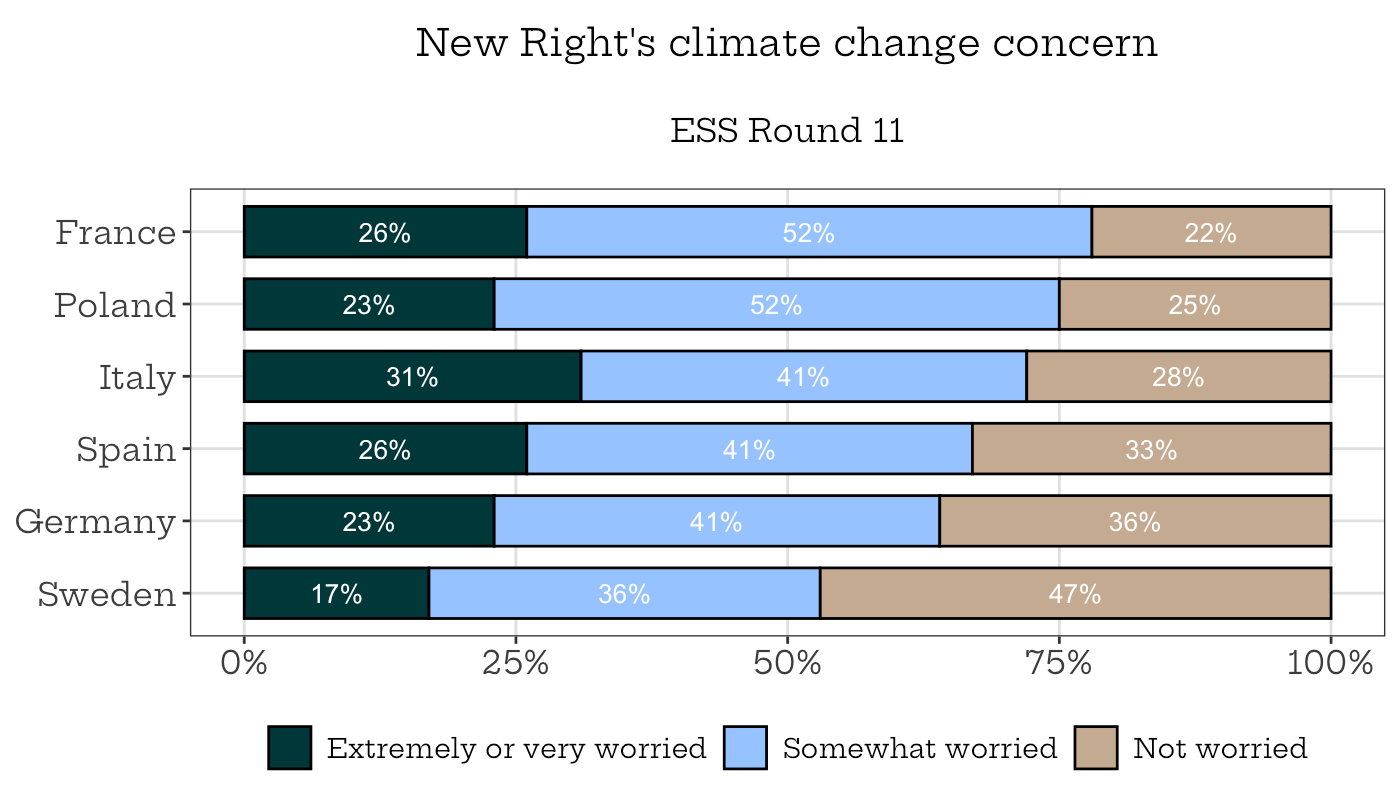
We also find important differences between countries. In France, for example, the gap between New Right and other voter groups is particularly small. This complicates the idea of a categorical divide between a climate-concerned mainstream and left, and an unconcerned New Right.
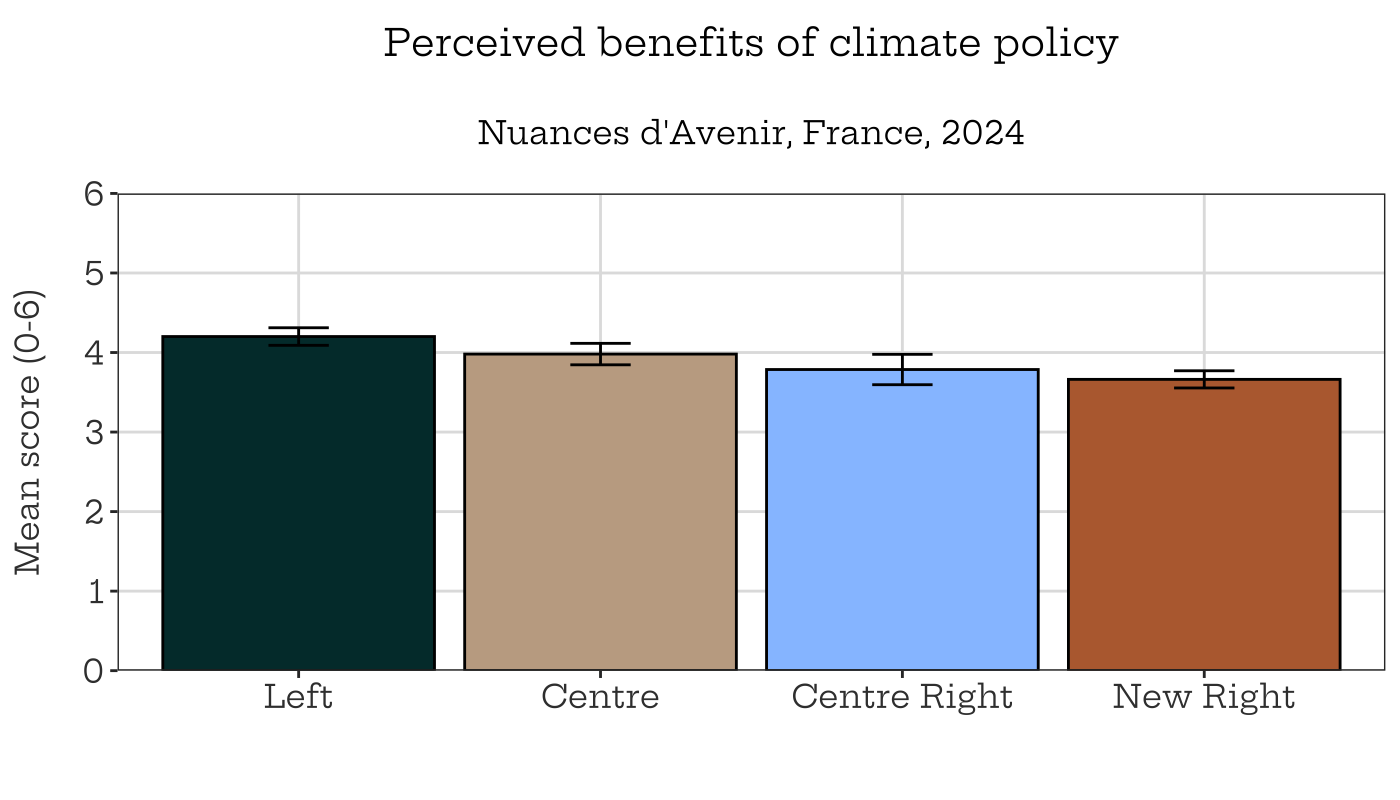
The more useful conclusion is not that political differences do not exist. They clearly do. It is that those differences coexist with meaningful concern - and likely with considerable diversity - among New Right voters themselves.
What should we do differently?
Researchers should present group differences in ways that make both their relative and absolute size clear. Graphs should display the full response scale and its labelled response options. When a shortened axis is used, it should be clearly marked so that small differences do not appear larger than they are.
Researchers should also present response distributions rather than relying only on averages. This allows readers to see whether New Right voters hold broadly similar views or whether the average combines groups with substantially different levels of concern. Where sample sizes allow, researchers could examine distinct segments within the New Right rather than treating these voters as a single category.
For policymakers, this helps identify where persuasion is, and is not, needed. If many New Right voters already express concern about climate change or environmental protection, the task is not to persuade them to care and that climate change is real. It may instead be to develop solutions that respond to that concern and that people consider fair, effective and worthy of support.
Interpretation mistake 2: Low salience does not mean rejection of climate policy
The problem
When people are asked to name the most important problems facing their country, climate change rarely appears at the top of the list. New Right voters are especially likely to mention issues such as the cost of living, immigration, public safety, healthcare or the state of the economy in the country first. This can be interpreted as evidence that they do not consider climate change and the environment important or will not support climate policy. But neither conclusion necessarily follows.
A “most important problem” question forces people to rank competing concerns. It tells us which issues feel most urgent at a particular moment. It does not tell us everything people care about, and it certainly does not tell us which specific policies they might support.
It is natural for immediate and tangible concerns, such as paying bills, finding work or feeling safe, to take priority over problems that are presented in abstract, distant or global terms. Mainstream climate policy often struggles to compete because it is not clearly connected to these more immediate priorities. Low salience should therefore not be treated as rejection. It may instead indicate that climate policy has not yet been designed and implemented in a way that responds to what voters consider most urgent.
What Shared Ground’s research shows
In our research in Italy, climate change and environmental problems rarely emerged spontaneously when New Right voters discussed the most important issues facing them. When prompted, however, participants said that they did find these problems important and wished the government did something to address them. They typically qualified this by explaining that other problems felt more immediate and needed to be addressed first. This illustrates the distinction between low salience and an absence of concern: the environment mattered, but it did not sit at the top of participants’ hierarchy of priorities.
The same research in Italy, as well as studies in Germany and Czechia, suggest that New Right voters can respond positively to environmental and climate policies when those policies also address their other, more immediate priorities. For example, support is stronger when proposals offer visible benefits, such as lower energy costs, secure jobs, stronger domestic industry, greater energy independence or more local control.
What should we do differently?
For policymakers, the key question is not: “How do we make climate change the New Right’s number one priority?” It is: “How can climate policy respond to more immediate priorities New Right voters already have?” This means starting with concerns such as household costs, jobs, energy security, industrial competitiveness and local control, and considering how climate policy can help address them.
Research should support this process by identifying and testing the trade-offs voters are willing to make. It should examine which policy benefits matter most, what costs voters consider acceptable, and who they trust to deliver a policy.
Part 2: How do we get better data?
Interpretation is only part of the problem. The conclusions we can draw from research also depend on the questions we ask. If the questions we use are too abstract, or if they combine several different aspects of a policy in a single question, they may not tell us what we actually need to know.
Measurement limitation 1: Abstract concern does not tell us which policies people will support
The problem
Surveys often measure climate attitudes by asking people whether they believe climate change is happening, whether they are worried about its consequences or whether protecting the environment is important to them.
As discussed in the previous section, our analysis reveals that environmental concern among New Right voters is not necessarily low. This is an important finding because it challenges the assumption that this audience is uniformly indifferent or climate-sceptic. But it does not, by itself, tell us which climate policies these voters will support.
Questions about general concern do not include the costs and trade-offs attached to concrete policy. Agreeing that climate change is important has no immediate effect on a respondent’s household bills, employment prospects, or local landscape, and it doesn’t change how they live their lives. A particular policy may affect all of these.
Crucially, many voters, and New Right voters in particular, may perceive economic prosperity and environmental protection as competing rather than complementary goals. Support for a climate policy is then weighed against its perceived effects on jobs, household costs and national competitiveness. This perceived trade-off, rather than indifference to the environment, may prevent general concern from translating into support for particular policies.
General concern about climate and a belief that environmental protection is important are therefore relatively weak predictors of policy support. A person can be worried about climate change and still oppose a particular measure because they consider it too expensive, unfair, ineffective or difficult to implement. And this applies across the political spectrum.
We should not infer blanket opposition from lower concern among New Right voters, or unconditional policy support from the higher concern among voters on the left. Abstract measures of climate concern cannot, on their own, tell us which concrete policies people will support.
What Shared Ground’s research shows
Shared Ground’s research suggests that broad climate concern is not sufficient to explain which policies voters will support. Across political groups, voters tend to be averse to measures they perceive as punitive or sacrifice-heavy, particularly those that would increase household taxes, energy bills or other everyday costs.
What should we do differently?
Researchers should not limit themselves to measuring general attitudes towards climate and move to testing concrete policy choices and trade-offs. Respondents should be given enough information to understand what a proposal would involve, including its likely costs, benefits and distributional effects. Researchers can then vary important elements of the proposal - its cost to households and concrete benefits the implementation of a policy would bring - to estimate how these influence policy acceptance.
For policymakers, this means that general measures of climate concern should not be treated as a reliable map of what is politically possible. Policy development needs evidence about specific designs, concrete trade-offs and the conditions under which support can be sustained.
Measurement limitation 2: Are we measuring opposition to the goal or to the policy package?
The problem
Even when surveys ask about concrete policies, the questions may combine several different things: the environmental objective, the policy instrument, its cost, the institution responsible for it and the political language used to describe it.
Many of the climate policies presented in surveys are strongly associated with the political left or perceived as “Brussels-made” solutions - designed by distant EU institutions and imposed from above. Given that scepticism about the EU is more prevalent among New Right voters, respondents may react not only to the environmental objective but also to the political and institutional signals attached to the proposal.
For example, rejecting an EU climate measure does not necessarily mean that a respondent opposes its environmental objective, or climate policy more broadly. They may instead be reacting to EU authority, the particular policy instrument, the distribution of costs, the perceived consequences for national industry, or language associated with a competing political camp. When these elements are bundled together, a single answer cannot tell us which aspect of the proposal is driving the response.
Political identity may also influence how freely voters express concerns about the costs of climate policy. Among left-wing voters, support for climate action may be socially expected, making some respondents less willing to admit that higher taxes, bills or personal sacrifices would reduce their support. New Right voters may feel freer to express these concerns, or may feel greater pressure to reject policies associated with the political left.
The apparent difference between political groups may therefore partly reflect differences in how comfortable respondents feel expressing particular views, rather than differences in their underlying assessment of the costs and trade-offs. This is a possibility that research should test in the future.
What Shared Ground’s research shows
Our research indicates that scepticism towards the European Union is one of the attitudes that most clearly distinguishes New Right voters from centre-right and other voters. This is particularly relevant to climate policy because many targets and measures are associated with the EU.
At the same time, our research in Germany, Italy and Czechia suggests that New Right voters may respond more positively when environmental policies are connected to energy security, national resilience, industrial competitiveness, stewardship and local control.
What should we do differently?
Research should separate the different components of a climate policy proposal. It should test whether support changes when the same environmental objective is pursued through different instruments, delivered by different institutions or accompanied by different distributions of costs and benefits.
For example, researchers could vary:
Whether a policy is led by the EU, the national government or local authorities;
Whether the main benefits are climate protection, energy security, cleaner air or industrial competitiveness;
Whether costs fall on the households, small businesses or big multinational companies;
Whether voters have choice and control over implementation.
This would help policymakers distinguish opposition to an environmental goal from opposition to a particular means of achieving it.
Finally, New Right voters are not a problem to be solved, and research should not be used simply to find the most persuasive way to sell them certain climate policies. Like all voters, they have their own concerns, priorities and ideas about what makes a good society. Taking these perspectives seriously is essential if we want to identify policies that can deliver meaningful environmental outcomes while reflecting voters’ priorities and respecting the trade-offs they are willing to make.
If you want to know more about the attitudes of New Right voters toward climate and environment, you can listen to our latest Reset by Shared Ground episode featuring Bruno Jeanbart from Opinion Way and myself “Beyond clichés - What New Right voters really think about the environment”.
And follow our activities on our website and on our LinkedIn page.