

Over the past few years, in Italy as much as in the rest of Europe, the environmental debate has too often been marked by unnecessary polarization.
While one side pushes for drastic and punitive measures (with negative consequences for ordinary people and our broader economic competitiveness), the other reacts with an “over-our-dead-bodies” discourse that may stem from an initial instinct of healthy skepticism, but too often drifts into an extreme opposition to environmental solutions altogether.
In the end, both postures (because this is what they are, postures) often end up damaging each political family, in no small part because these two extreme positions are nowhere near those of ordinary people. After all, citizens – including the most conservative of them – do know and see that our ecosystems are fragile, and that we must take care of them if we want to pass on to our descendants the clean air, nature, and, more generally, the beauty of the landscapes and heritage that our ancestors left to us, and that we enjoyed in our childhood.
Proposition: when environmental issues are discussed through everyday concerns such as nature, health, food, place and resilience voters right and left are not as dissimilar as one thinks. Everyone wants to breathe clean air and drink pure water. And like many others in Europe and beyond, Italians in general are actually asking for credible and pragmatic answers to ecological challenges, including when they vote on the right. And if conservative politicians do not provide them those answers, they will miss an opportunity to address an issue that lies at the heart of voters’ concerns – and consolidate their electorate.
What happens if they don’t? We actually already saw the result in 2019, when a strong green wave enabled the left to achieve excellent electoral results in the European elections and then impose its own version of a Green Deal that was unacceptable to the right and is now challenged by a new majority in the European parliament.
It would, however, be unfair to blame the left for the shortcomings of the Green Deal. Part of the problem was that the right had no real, positive alternative to propose — one that would be credible and authentic and rooted in conservative values such as localism, humanism and pragmatism.
Today, the fact remains that many voters, especially young people, are looking for concrete solutions to environmental issues. Solutions that align with their values: local roots, security, continuity, and fairness. And if conservatives do not offer a positive and coherent vision on this issue, they leave the field open to those who already have another narrative ready. It is precisely to fill this vacuum that we at Shared Ground are stepping in, with a more mature and responsible approach.
This is what we at Shared Ground have been working on for the past year: how to empower conservatives in Italy (and hopefully more widely in Europe) to get back into the environmental debate and to propose solutions to the major ecological issues of our time, including climate change. This is why we have worked for nine months with conservative politicians, experts, and civil society representatives who have been working on these issues for many years, in order to outline a truly conservative environmental policy for Italy. In other words, a manifesto for green conservatism that is authentically conservative and authentically ecological. The idea is to empower those who care about the environment on the right so that they can be bolder, and show what they propose, not only what they reject.
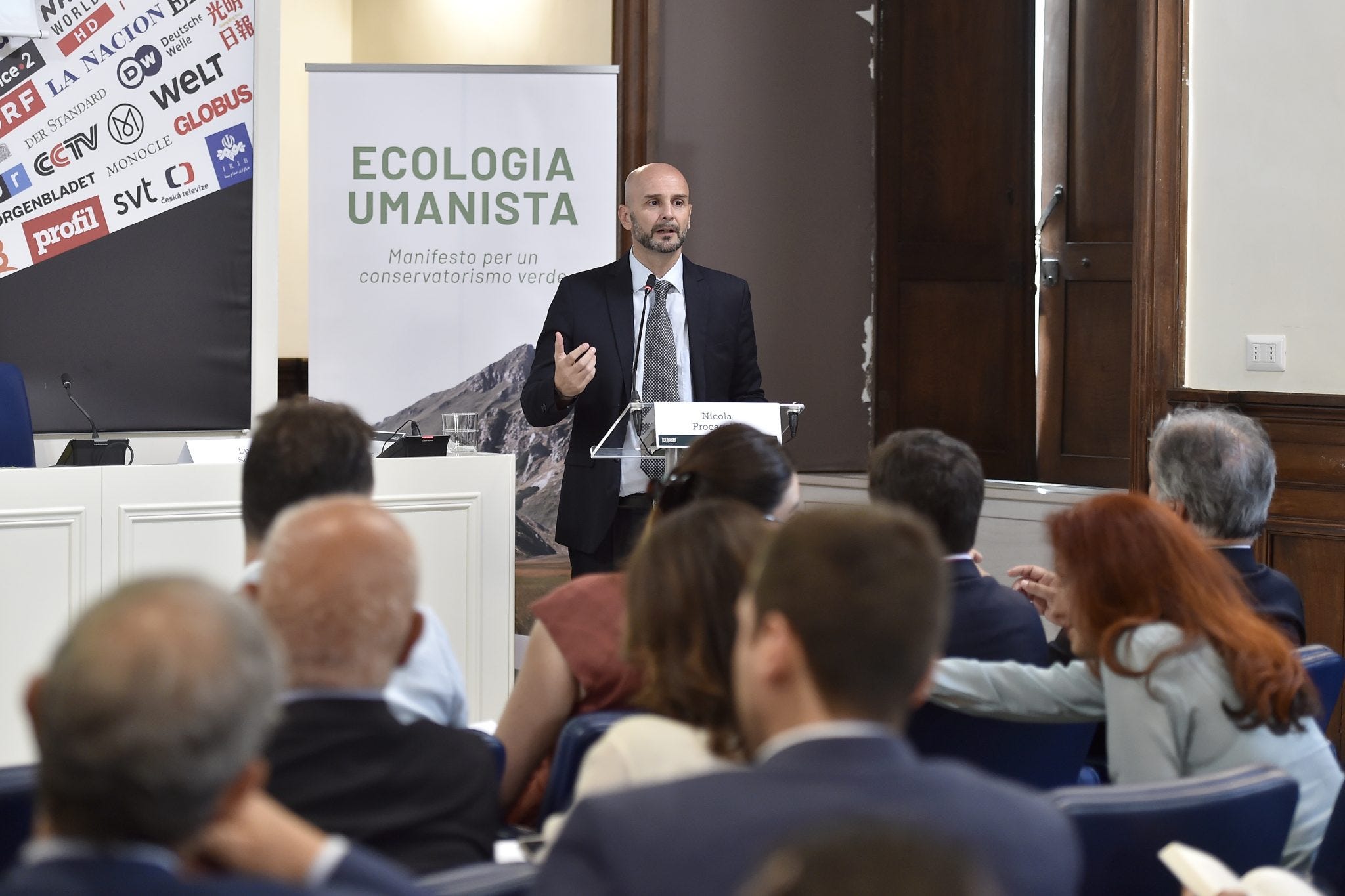
This positive alternative is the subject of the long “Manifesto for a Green Conservatism” that we presented last month to the Italian public in Rome. It is a programmatic alternative to the left’s environmental agenda, and it is divided in three parts: a short, programmatic text summing up the features of a conservative approach to the environment, a series of seven position papers summing up the main political choices that could be taken by the majority in their programmatic approach ahead of the 2027 general elections, and finally six more technical policy papers that can be implemented right now by the government if it wishes to do so.
Because they were created by conservatives and (classical) liberals stemming from the current centre-right majority, the policies and ideas presented in this book are all rooted in the values that make the different components of the current political majority in Italy: pragmatic, rooted in communities, with a goal of self-sufficiency, respect for the natural world that we inherited from God and from our ancestors, and above all a human-centered vision of what an environmental policy should be. This humanist vision is important, because, ultimately, we protect the environment for ourselves and for our children, not for abstract ideologies that confuse ecology with social engineering.
All of these themes (and many others) are addressed in the publication – co-published with the Italian publishing house Giubilei Regnani, and is now available on our website. Its content is 100% “Made in Italy,” with proposals that are 100% Italian, conceived by Italians for Italy – at no point did we suggest – let alone impose – any solutions that would actually have been counterproductive. After all, project participants have a long experience in thinking about and dealing with the environment, and their political philosophy is already solidly anchored in their conscience. This has made our work all the easier. All we had to do was to bring these people together in an inspiring environment, and let them do their magic.
This month, we will present you their work – in the next Substack of course, in which we will let one of our authors talk about their work, and in a new episode of our podcast, where we will go deeper into the details of our proposals. We expect these elements (and above all the manifesto) to be a good starting point for an important conversation to depolarize the environmental debate and rediscover a constructive consensus for the environment - in Italy and beyond.
-Thibault Muzergues, Political Director, Shared Ground.