

Written by Alarico Lazzaro (Editor in Chief, Nazione Futura) for Shared Ground
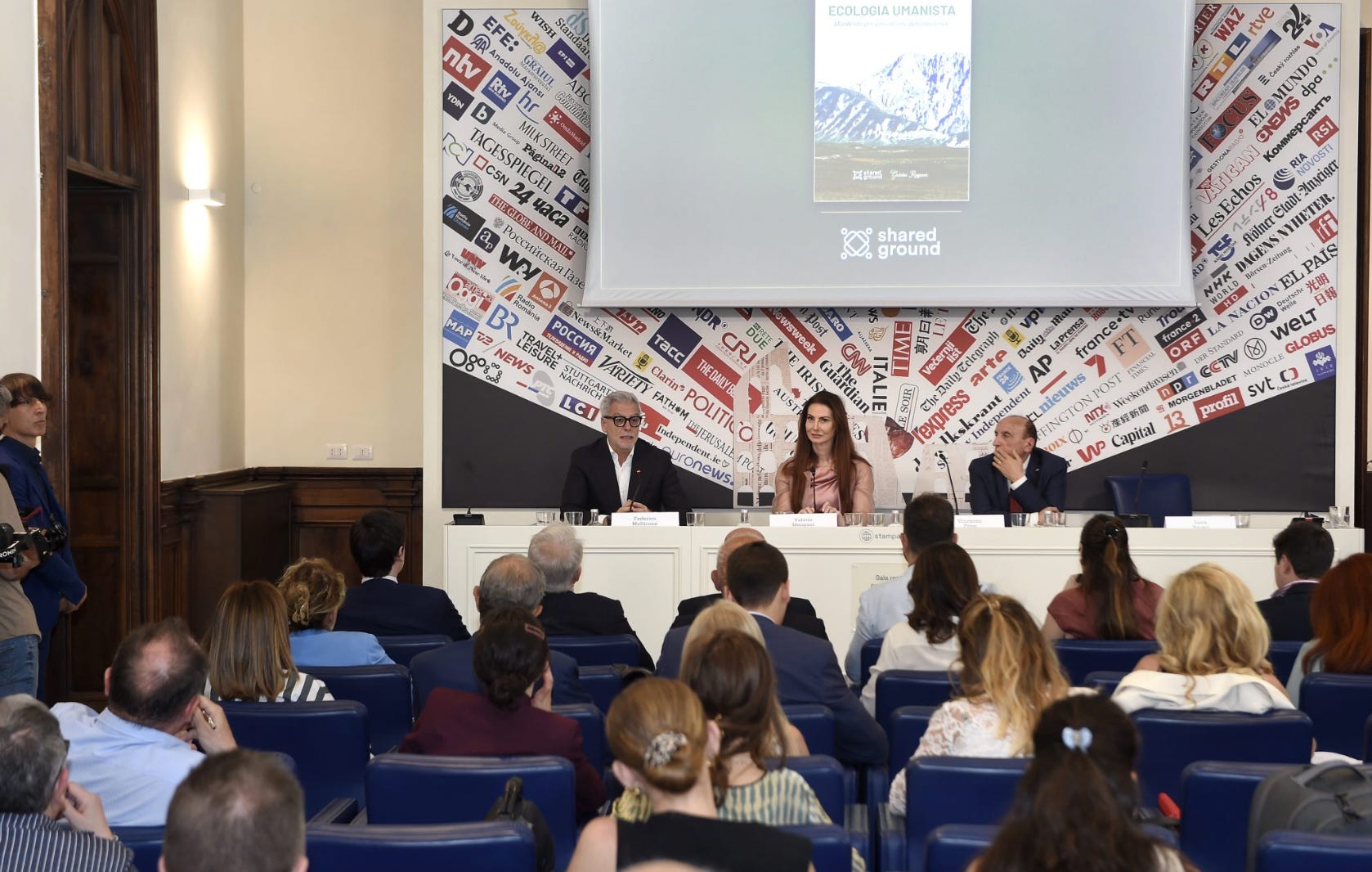
A packed room in an extremely evocative setting, Palazzo Grazioli, and a project that for over a year has involved institutions, think tanks, civil society, experts and journalists in a constant and enriching discussion on the environmental issue, which has always been paradoxically considered an exclusive of the left or the progressive world.
On June 19th, something changed. At the headquarters of the Foreign Press in Palazzo Grazioli, the think tank Shared Ground and its Italian partners presented Humanist Ecology, published by Giubilei Regnani - the collection of a year of work around the idea that the protection of the territory is purely conservative. The participation of Minister Nello Musumeci and former Minister Corrado Clini also enhanced the institutional support for the project.
A single imperative: to restore common sense and pluralism to the public debate on issues related to the green transition, renewables, the infrastructure revolution and energy sovereignty.
Those are fundamental connotations of a changing time and pillars of what Roger Scruton called oikophilia – a celebration of ecology as the quintessence of the conservative cause, making use of the symbiosis between tradition and identity to analyze themes such as the protection of biodiversity, the defense of the environment and the protection of the sacred and creation.
Precisely, the oikos is the beating heart of conservative ecologism. Defending the environment is part of the Scrutonian oikophilia, a memory that branches out into the attachment to one’s roots, to one’s own experience, to one’s ideal, dialectical, spiritual heritage.
Oikophilia is opposed to oikophobia, the tendency to self-flagellation of the Western world that between victimhood and deconstruction has turned the environment into a shield onto which catastrophic and harmful narratives are built.
The Manifesto “Ecologia umanista” brings back to the center of the public debate “the Italian way for a humanist, responsible, competitive ecology” in a crucial phase for the European Union and for its member states.
The new multipolarity also requires reflections to recover competitiveness, to resist and to adapt.
The European Union is in fact the most advanced region in the world in decarbonization but at the same time, as pointed out in the Manifesto, it is also the least competitive due to energy costs which are two or three times higher than competitors.
Conservative ecology was born precisely to counterbalance the green maximalism of progressive fringes, to reaffirm the need that “nature cannot be defended by destroying the society that inhabits it”. True sustainability, in fact, begins with a culture of daily respect for the environment and its heritage, a culture of respect for the landscape and for the subtle balance between man and his surroundings.
Thus, the right aims to create a clear change of pace also from a dialectical point of view, moving from the narrative of “prohibiting” to that of “promoting”.
A strategy of great realism aimed at governing change rather than being subject to it, at mastering phenomena without becoming enslaved to them, with a view to pursuing a concrete path towards energy sovereignty.
After all, the environment has entered the political agendas thanks to the commitment of many conservatives.
It was Margareth Thatcher who warned against the effects of climate change, for a tradition of the green Tories that has survived even during her successors, above all Boris Johnson.
A green sacrality also embodied in the works that have made British literature immortal and that allow us to understand the depth of a nation.
Among the most famous examples, J. R. R. Tolkien configured the deforestation of the ENTs, brothers of Treebeard, by Saruman, as the first piece for the triumph of evil and darkness in Middle-earth, representing the dense clearings of Hobbiton as the metaphor of a benign nature, in antithesis to the dark forces.
C. S. Lewis, who in life was a fraternal friend of Tolkien and who for posterity was the eternal author of The Chronicles of Narnia, metaphorically configured the themes of spiritual resurrection with the return of Aslan, declining them through a bucolic rebirth of greenery and nature.
It was conservative leaders who established national parks and green areas, above all the famous Republicans Ulysses Grant and “Teddy” Roosevelt, and General De Gaulle who today seems to have inspired even the green agenda of the new course of Marine Le Pen and the Rassemblement National.
Ruralism, defense of the environment and traditions has also become a trademark of the Euro-realist parties of the East, above all Law and Justice in Poland.
An unequivocal sign that the conservative ecology revolution continues to expand in the Old Continent and that Italy needs a clear change of mindset on the issue.
For this reason, the book of Shared Ground enriched by the contributions, in addition to the preface by Nicola Procaccini, of Massimiliano Atelli, Rodolfo Belcastro, Valentina Colucci Fabrizio, Walter Da Riz, Gabriella De Maio, Francesco Galietti, Francesco Giubilei, Alarico Lazzaro, Lorenzo Letta, Valeria Mangani, Ciro Miale, Lorenzo Montanari, Thibault Muzergues, Ildebrando Panfili, Vincenzo Pepe, Simone Rosati, Elisa Scotti, Michele Vitiello, Natalia Węgrzyn, is an essential text to give concrete feedback to a new ecological path.
As pointed out by Natalia Węgrzyn and Thibault Muzergues, respectively Executive Director and Political Director of Shared Ground, it is necessary to create a programmatic alternative to the left’s agenda, “rooted in communities, in self-sufficiency, in respect for the natural world that we have inherited from God and our ancestors, especially in a vision in which the human being remains at the center” and with a watchful eye to the future.
A pragmatic, realistic environmentalism free from any form of messianism brings the human being back to the center of reflections but above all tries to combat some of the structural problems of the Belpaese including demographic crisis and depopulation of inland areas and small municipalities.
Conservative ecology is never a brake on development: it is its most conscious accelerator. It must be defended and represents a political and cultural frontier of great depth to avoid strategic, energy and geopolitical dependencies in the future and encourage technological development well mediated by strategic rationality.
Conserve to innovate and innovate to last is undoubtedly the most far-sighted of mantras.